Sarawak Work Permit AP Quota: Requirements + Worked Examples (2026)
Citra Excel

Hiring foreign workers in Sarawak requires a series of government approvals before a work permit can be issued. Each step — from the initial Hiring Outcome Report to the final PLKS issuance — has its own document checklist and sector-specific requirements, and skipping ahead is how applications get sent back. For agency-managed lodgement of the AP, Labour Licence, and PLKS, see our general workers service. If you are weighing up lodging it yourself against using an agent, the split between what an agent can file and what stays with you as the employer is set out there.
Need help with your application? Citra Excel handles the entire process end-to-end. Call us at +6011-1113 8685 or WhatsApp us for a free consultation.
What Is the PLKS Work Permit?
The Pas Lawatan Kerja Sementara (PLKS), or Visitor's Pass (Temporary Employment), is the work permit issued to foreign nationals employed in Sarawak. It is valid for 1 year and renewable, subject to compliance with all legal requirements. The overall permit validity for general and skilled workers spans 6 to 10 years.
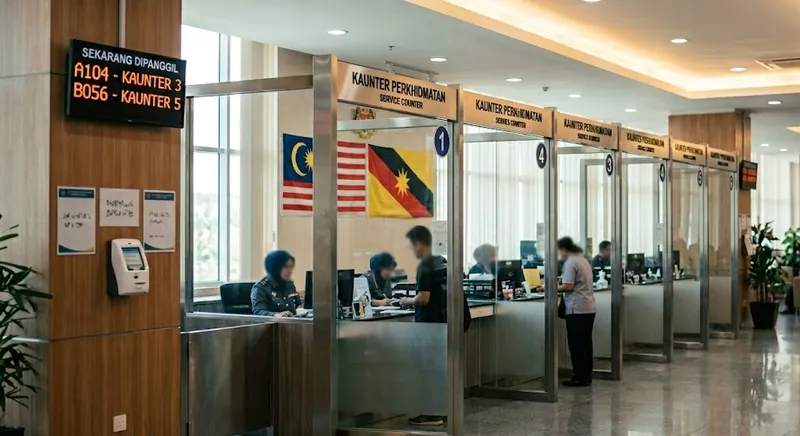
The PLKS is collected from the Immigration Department of Malaysia, Sarawak (JIMS) after all prior approvals are in place. It is a separate permit from work passes issued in Peninsular Malaysia — a work permit from West Malaysia is not valid in Sarawak.
Eligible Sectors
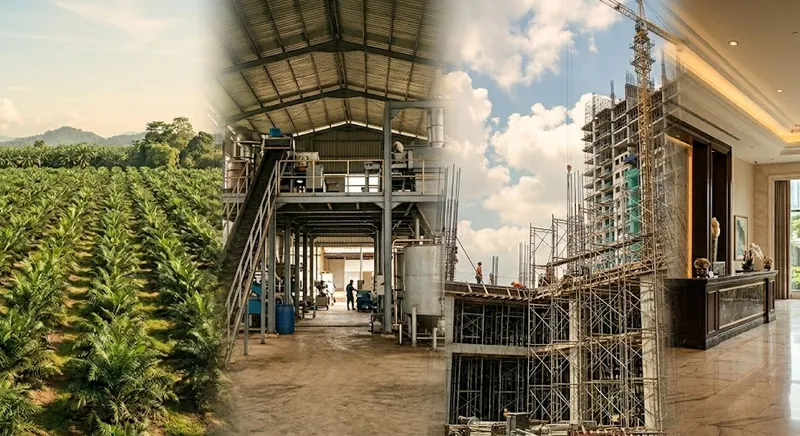
Foreign workers in Sarawak are permitted in the following approved sectors:
- Manufacturing
- Plantation
- Construction
- Logging
- Mining / Quarrying
- Services — including restaurants, laundry, warehouses, recycling/waste management, and other service sectors approved from time to time
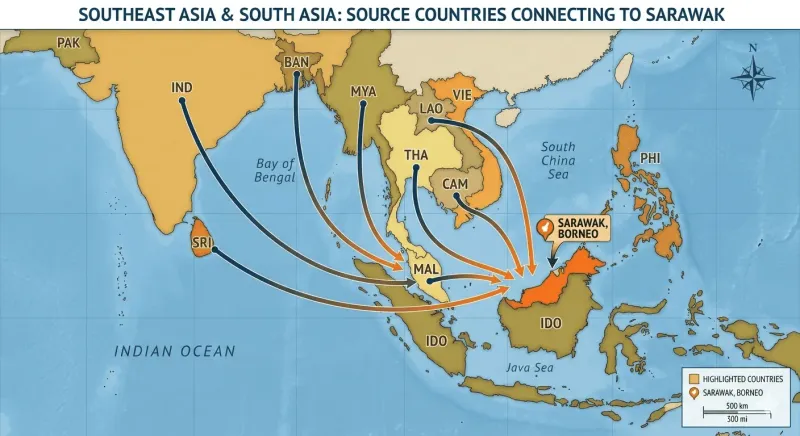
The source countries available to you depend on your sector and whether you are hiring general or skilled workers. For the full breakdown, see our guide on eligible source countries for foreign workers in Sarawak.
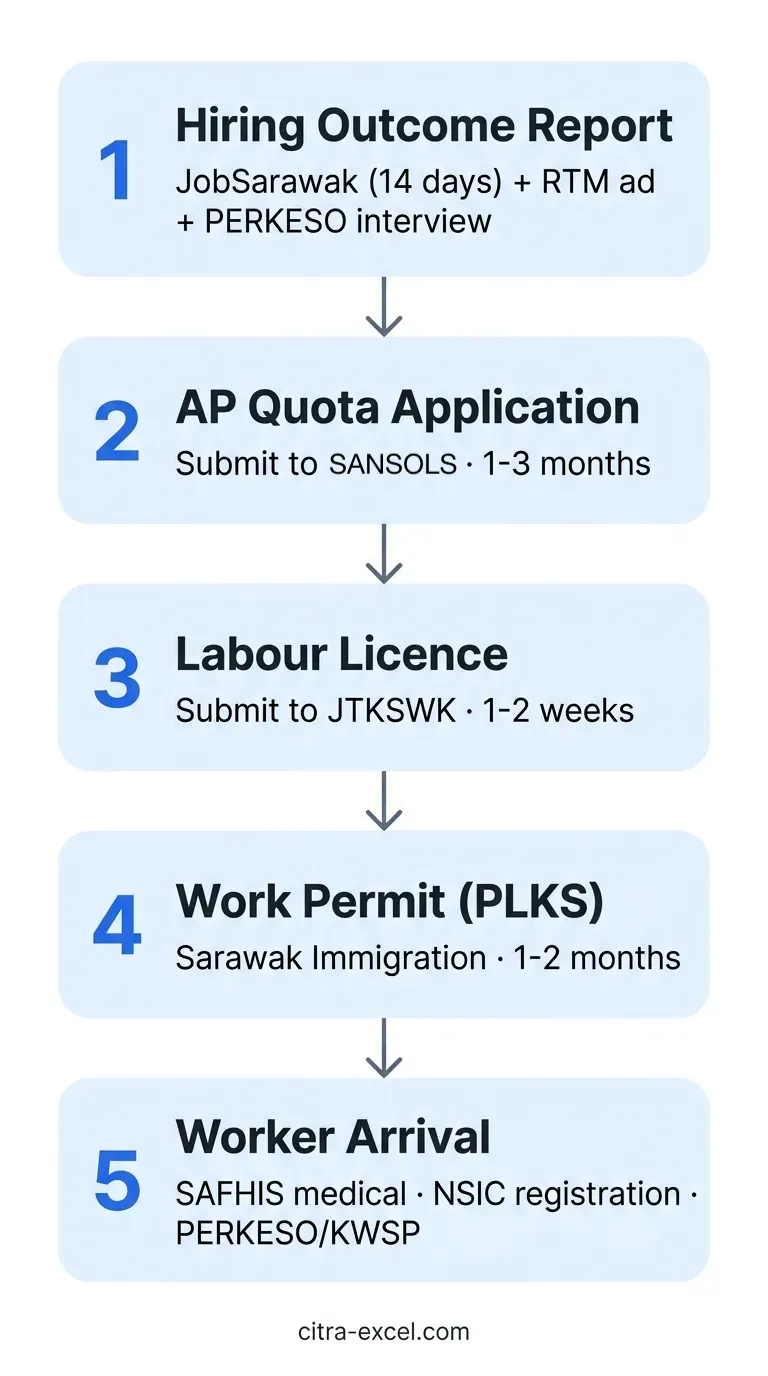
Overview of the Sarawak work permit application process
Step 1: Hiring Outcome Report
Before applying for an AP quota, employers must demonstrate that they have made genuine efforts to hire locally. This involves:
- Advertising the position on JobSarawak
- Advertising on regional radio
- Arranging an open interview session with PERKESO (SOCSO) to confirm that no suitable local candidates were found
Once these steps are completed, a Hiring Outcome Report (HOR) is issued, which you will need for the AP application. The HOR typically takes 16 to 20 days.
Exemptions: Key posts, shareholders, specialists, and cross-postings are exempt from the Hiring Outcome Report requirement.
Step 2: AP Quota Application
The Approval in Principle (AP) is submitted to the Sarawak Labour Department (JTKSWK). As of 15 January 2025, all AP applications must be submitted online. The AP authorises your company to hire a specified number of foreign workers for approved positions and source countries.
Documents required for AP application (uploaded in SANSOLS):
- Cover letter
- Business licence
- Business registration certificate (SSM)
- Confirmation of interview results by PERKESO (SOCSO)
- Borang 49 and Borang 24 (for Sdn. Bhd. / Ltd. companies)
- Hiring Outcome Report
Certain sectors require additional documents — see sector-specific documents below.
Processing time: AP applications typically take 1 to 3 months to process, depending on the completeness of your documentation and current processing volumes.
Step 3: Labour Licence
Once the AP is approved, the next step is to apply for a Labour Licence with JTKSWK. This is a separate requirement under the Sarawak Labour Ordinance.
Documents required for Labour Licence (the required supporting documents are uploaded in SANSOLS):
- Cover letter
- Employee passport copy (information page and travelling visa)
- Copy of academic qualification certificate (as per the advertisement)
- Copy of testimonial (as per the advertisement)
Processing time: Labour Licence applications typically take 1 to 2 weeks.
Step 4: Work Permit (PLKS) Application
With the AP and Labour Licence approved, the work permit application is submitted to the Immigration Department of Malaysia, Sarawak (JIMS). Entry is authorised through the eVDR (e-Visa Dengan Rujukan), applied online via the eVDR module within ALIANCE once the Labour Licence is approved and paid. The eVDR uploads include the insurance or bank-guarantee proof, SPIKPA/SKHPPA, and the worker's source-country medical result.
Prerequisites for PLKS issuance:
- Approved and valid AP
- Approved Labour Licence
- Fit status medical screening report from source country
- Fit status medical screening report from SAFHIS (after arrival)
Processing time: Work permit applications with Sarawak Immigration typically take 1 to 2 months.
Sector-Specific Documents
In addition to the standard AP documents, each sector requires specific supporting documents:
| Sector | Additional Documents Required |
|---|---|
| Manufacturing | Manufacturing licence issued by MITI |
| Construction | Confirmation of project award + CIDB certification/registration |
| Logging / Timber | Forest Department registration certificate / STIDC certificate |
| Agriculture | Aquaculture/livestock licence from Department of Agriculture + land title from Department of Land & Survey or GLC agreement |
| Plantation | Land title from Department of Land & Survey / MPOB licence (for oil palm smallholders) |
| Mining / Quarry | Licence for extracting bauxite, sand, or quarrying from Department of Land & Survey |
| Metal / Used Items Trading | Permit from PDRM (Royal Malaysia Police) for trading metals, used items, and recycled items |
| Spa / Reflexology | Licence under The Local Authorities (Reflexology and Health Establishment) By-Law 2009 |
| Swiftlet Rearing | Licence from Forest Department Sarawak / Department of Agriculture / Local Authority |
| Water Treatment / Mineral Water | Factory licence from Ministry of Health Malaysia |
Step 5: Worker Arrival & Post-Arrival
Once the worker arrives in Sarawak, several post-arrival requirements must be completed:
- SAFHIS medical screening — must be completed within 30 days of arrival at a SAFHIS panel facility
- PLKS collection — the work permit is collected from JIMS after all requirements are met
- NSIC registration — the worker must visit the Immigration & Labour Integrated Centre (ILC) for fingerprint and photo registration to obtain their Non-Sarawakian Identity Card, issued during a pre-booked ILC appointment (booked after the PLKS is issued)
- PERKESO (SOCSO) registration — mandatory social security registration (see our PERKESO guide)
- KWSP (EPF) — provident fund registration
- Health insurance — as required by law
For a full list of documents required at each stage, see our document checklist for foreign worker recruitment.
Ready to apply? Get a free consultation.
Citra Excel handles the entire AP quota and work permit process for you — from document preparation to worker arrival.
Worked Examples: Three Scenarios
The same AP framework applies across sectors, but the practical numbers differ. Three illustrative scenarios — a small retail outlet, a mid-sized manufacturer, and a large plantation operator — to show how the review plays out:
Scenario 1: Retail / F&B Outlet (10 staff)
A Kuching restaurant with 10 staff (8 local, 0 foreign) wants to hire 2 foreign general workers for kitchen and service support.
- Justification: shift coverage and persistent local-recruitment failure during the post-COVID labour shortage
- HOR requirement: JobSarawak advertisement + regional radio listing + PERKESO open interview confirmation (typically 16–20 days)
- Sector documents: SSM business profile, premise licence from local council (e.g. MBKS Kuching), outlet listing if part of a chain
- AP review focus: outlet size and seating capacity, headcount-to-premise ratio, evidence that local recruitment was attempted in good faith
- Local-to-foreign ratio: services / F&B has the tightest sector benchmark in Sarawak — quota allocations here are smaller and more scrutinised than other sectors
- Realistic AP quota: 1–2 workers approved on first application; expansion only after a clean compliance cycle
- Timeline: 4–8 weeks AP, 1–2 weeks Labour Licence, 2–3 months PLKS = approximately 4–6 months total to first worker arrival
For F&B specifically, accommodation is the single most-cited rejection reason — most outlets in shop-lot premises do not have inbuilt staff quarters and need a separately rented residential block compliant with the Workers' Minimum Standards of Housing and Amenities Act 1990.
Scenario 2: Manufacturer (50 staff)
A Bintulu-area light-manufacturing company with 50 staff (38 local, 4 foreign on existing PLKS, expanding) wants to add 8 more foreign general workers to support a new production line.
- Justification: production expansion with new contract; existing local workforce stable but unable to meet the new line's volume
- HOR requirement: JobSarawak advertisement + regional radio listing + PERKESO open interview (typically 16–20 days); HOR exemption may apply for highly skilled positions but general production roles still require it
- Sector documents: SSM, MITI manufacturing licence, Borang 49 / Borang 24, latest audited accounts, production capacity declaration
- AP review focus: local-to-foreign ratio (target ~70:30 in many manufacturing sub-sectors), production capacity vs proposed headcount, premise capacity, manufacturing-licence currency
- Local-to-foreign ratio: proposed total would be 38 local + 12 foreign (24% foreign) — within typical manufacturing benchmarks
- Realistic AP quota: 8 workers achievable if ratio and justification hold; first-time applicants face a more thorough review than established employers
- Timeline: 4–8 weeks AP, 1–2 weeks Labour Licence, 1–2 months PLKS = approximately 3–5 months total to first worker arrival
Established manufacturers with a clean track record and consistent compliance often see faster cycles on subsequent APs. The first AP is the high-friction one.
Scenario 3: Plantation Operator (200 staff)
A Miri-area oil palm plantation with 200 staff across multiple estates (60 local, 140 foreign on existing PLKS, replacing) wants to apply for 50 foreign worker quota to backfill end-of-contract departures.
- Justification: hectarage-to-worker ratio for the planted area; replacement headcount, not net expansion
- HOR requirement: JobSarawak advertisement; HOR sometimes streamlined for plantation roles given known local-supply gap, but the formal process still applies
- Sector documents: SSM, land titles from Department of Land & Survey for each estate, MPOB licence (if smallholder), planted hectarage declaration, sector body endorsement
- AP review focus: hectarage-to-worker ratio (each sub-sector has its own multiplier — oil palm differs from pepper or rubber), MPOB cross-reference, replacement-vs-expansion split
- Local-to-foreign ratio: plantation accepts higher foreign proportions than other sectors due to known local-supply constraints — 140 foreign out of 200 is within benchmark for established estates
- Realistic AP quota: 50 replacement positions achievable for an established operator with clean MPOB and Land & Survey records; new-estate APs face more scrutiny
- Timeline: 4–8 weeks AP, 1–2 weeks Labour Licence, 1–2 months PLKS = approximately 3–5 months total to first worker arrival; replacement APs sometimes compress faster
For plantation operators with multiple estates, the document pack scales with the number of estates — each one needs its own land title, hectarage declaration, and accommodation certification. Operators sometimes lodge consolidated APs covering several estates simultaneously.
Across all three scenarios: the dominant variable is the completeness of the document pack at first lodgement. Files with gaps loop through clarification rounds and stretch from a 4-month best case to 6+ months. The investment in getting the file right at lodgement repays itself in calendar time.
Frequently Asked Questions
How long does the AP quota application take in Sarawak?
The AP (Approval in Principle) application typically takes 1 to 3 months to process, depending on the completeness of your documentation and current processing volumes at JTKSWK.
What sectors are eligible for foreign worker work permits in Sarawak?
Sarawak allows foreign workers in Manufacturing, Plantation, Construction, Logging, Mining/Quarrying, and Services (including restaurants, laundry, warehouses, and other approved service sectors).
What is the difference between an AP and a Labour Licence?
The AP (Approval in Principle) authorises your company to hire foreign workers and specifies the number and positions approved. The Labour Licence is a separate requirement under the Sarawak Labour Ordinance that must be obtained before workers can begin employment.
How long is the PLKS work permit valid?
The PLKS is valid for 1 year and is renewable, subject to compliance with all legal and procedural requirements. The overall work permit validity for general and skilled workers is 6 to 10 years.
Do I need to advertise the job before applying for an AP?
Yes. Employers must advertise the position on JobSarawak and on regional radio to obtain a Hiring Outcome Report before submitting an AP application. The HOR typically takes 16 to 20 days. Exemptions apply for key posts, shareholders, specialists, and cross-postings.
How is AP quota calculated for a small business?
Sarawak's AP review balances three factors: the size of the business (premises, headcount, revenue), the sector's local-to-foreign ratio benchmark, and the demonstrated need shown through the Hiring Outcome Report. A 10-staff retail outlet, a 50-staff manufacturer, and a 200-staff plantation all face the same review framework but very different sector-specific quota benchmarks. See the worked examples above for how the review plays out in each case.
References
- GENESIS — SANSOLS Visitor's Pass (PLKS) — Eligible sectors, required documents, and validity
- GENESIS — General Worker Classification — Eligible industries and source countries
- GENESIS — Skilled Worker Classification — Eligible industries and source countries
- GENESIS — SANSOLS FAQ — AP application and Labour Licence requirements
- JTKSWK — Garis Panduan Permohonan AP dan Lesen — AP and licence application guidelines
- Labour Ordinance (Sarawak Cap. 76) — Section 119 (Employment Licence)
- JobSarawak — Official Sarawak job portal for Hiring Outcome Report
Our website and its contents are provided for general information purposes only and nothing on this website or in its contents is intended to provide professional advice. Please contact us at hello@citra-excel.com or +6011-1113 8685 for more information.
Need help with foreign worker recruitment?
Contact Citra Excel for a free consultation.