Permit Kerja Sarawak 2026: Documents & Timeline by Sector
Citra Excel

A foreign-worker permit in Sarawak is not one process — it is five processes that share a common framework. Approved source countries, document packs, accommodation rules, quota allocation, and AP-to-arrival timelines all shift depending on the sector. Treat all five as the same process and you will prepare the wrong documents for your sector — the side-by-side below sorts them so you do not. For agency-managed lodgement across the manufacturing, plantation, construction, and services sectors, see our general workers service.
The Five Sectors Covered
The Sarawak foreign-worker framework recognises five primary sectors. Each has its own documentary requirements and source-country list:
- Domestic Helper — Sarawak families hiring a maid for household work
- Plantation — oil palm, pepper, agriculture (treated similarly for permit purposes)
- Construction — building, civil works, infrastructure projects
- Manufacturing — factories, processing plants, light and heavy industry
- Services / F&B — restaurants, hotels, cleaning, retail (a broad bucket)
There are also specialised tracks — Employment Pass for skilled professionals, PLIK, the Professional Visit Pass, for offshore oil and gas and maritime — but these are not the general foreign-worker permit and are covered separately.
Approved Source Countries by Sector (Skilled Workers)
General Workers: only Indonesian nationals are currently approved for the General Worker classification across all sectors in Sarawak. The country list below applies to Skilled Worker classifications only.
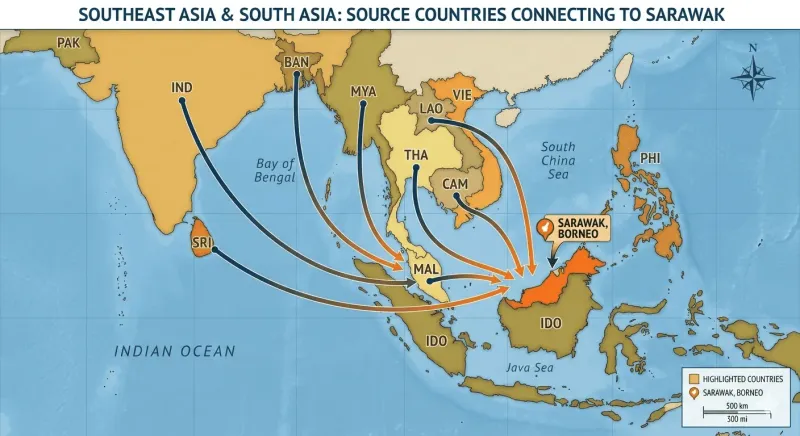
For Skilled Workers, the list of countries from which a sector can recruit is set by the Jabatan Imigresen Malaysia Sarawak in coordination with JTKSWK. The lists overlap but are not identical:
| Sector | Typical approved sources |
|---|---|
| Domestic Helper | Indonesia, Thailand, Cambodia, Philippines, Sri Lanka, India, Vietnam, Laos, Nepal |
| Plantation | Indonesia, Bangladesh, Nepal, India, Myanmar, Cambodia, Laos |
| Construction | Indonesia, Bangladesh, Nepal, Vietnam, Myanmar, Pakistan, Cambodia |
| Manufacturing | Indonesia, Bangladesh, Nepal, Vietnam, Myanmar, India, Sri Lanka, Pakistan, Cambodia, Laos |
| Services / F&B | Indonesia, Bangladesh, Nepal, Vietnam, Cambodia (more restricted than manufacturing) |
The lists are reviewed periodically and can change with bilateral agreements. For the latest authoritative list, see our eligible source countries guide or the official Jabatan Imigresen Malaysia Sarawak announcements.
A common confusion: federal Peninsular lists differ from Sarawak's. A worker eligible for Peninsular manufacturing is not automatically eligible for Sarawak manufacturing — the lists are state-controlled.
Quota Framework by Sector
Quota is the headcount allowance an employer is permitted to recruit, awarded through the Approval-in-Principle (AP) process. The basis differs by sector:
| Sector | Quota basis |
|---|---|
| Domestic Helper | Per household, generally one per qualifying family unit |
| Plantation | Worker-to-hectare ratio, with sector-specific multipliers |
| Construction | Project-based, tied to the contract value, project duration, and approved manpower plan |
| Manufacturing | Local-to-foreign worker ratio (a target proportion of foreign workers in total headcount) |
| Services / F&B | Per outlet / per branch caps, often more restrictive than manufacturing |
For a deeper walkthrough of how AP quota is calculated and applied, see our dedicated Sarawak AP quota guide.
Documents Required by Sector
The core document pack is similar across sectors, but each adds sector-specific items.
Always required (all sectors):
- Employer's SSM business registration / company profile
- Employer's latest financial statements or audited accounts
- Approved AP letter from JTKSWK
- Worker's passport (original + bio-page copy)
- Worker's medical-fitness certificate
- Employment contract
- Personal Bond / Security Bond paperwork
- SPIKPA insurance cover
- PERKESO foreign-worker registration
- Approved accommodation certificate (Act 446)
Sector add-ons:
- Domestic Helper: Family income declaration, household composition, KJRI Kuching registration certificate (SIPERMIT) for Indonesian helpers, MWO (Migrant Workers Office, formerly POLO) clearance for Filipino helpers
- Plantation: Land title or lease, planted hectarage declaration, sector body endorsement (e.g. MPOB for oil palm)
- Construction: Project contract, BOM/BQ where requested, manpower deployment plan, project timeline
- Manufacturing: Manufacturing licence (where applicable), production headcount declaration, local-vs-foreign ratio justification
- Services / F&B: Premise licence, halal certification (where applicable), outlet listing for chain operators
For the deep checklist, see our documents-required guide.
Typical Timeline: AP to Arrival
Timelines vary with completeness, season, and source-country processing. The ranges below are realistic, not best-case:
| Sector | AP-to-arrival typical range |
|---|---|
| Domestic Helper (Indonesia / SIPERMIT route) | 2–4 months |
| Domestic Helper (Philippines / MWO route) | 4–6 months |
| Plantation | 2–4 months |
| Construction | 2–5 months |
| Manufacturing | 3–5 months |
| Services / F&B | 3–6 months |
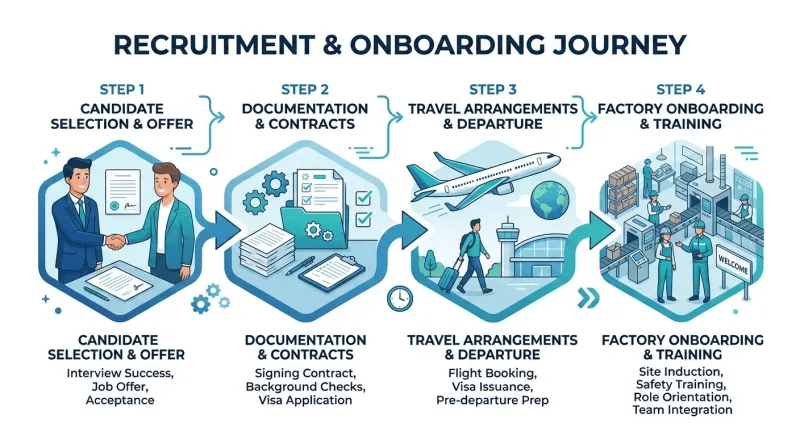
The dominant variable is source-country processing — Philippines MWO clearance is consistently the longest on the list. Within Sarawak, AP processing usually takes 2–6 weeks once a complete file is lodged; longer if anything is missing. See our recruitment-process guide for the full step sequence.
Accommodation Rules by Sector
The Workers' Minimum Standards of Housing and Amenities Act 1990 (Act 446) applies across sectors but the practical compliance pattern differs:
- Domestic Helper: Worker stays in the employer's home; private room expected, with reasonable rest and meal arrangements
- Plantation: On-site worker quarters near the estate; longhouse-style or bunkhouse layouts common; sanitation and water supply are the main inspection points
- Construction: Worker camps near the project site; temporary structures with stricter density limits; site safety adjacent to housing
- Manufacturing: Off-site dorms or rented residential blocks; density limits, fire safety, and ventilation are the most-cited inspection issues
- Services / F&B: Often the most challenging — outlets in shop-lot premises rarely have inbuilt accommodation; employers typically need to rent off-site blocks meeting Act 446
A Certificate of Accommodation (CoA) issued by the Sarawak Labour Department is part of the document pack. No CoA, no AP.
Common Rejection Reasons by Sector
Understanding why APs and applications get rejected, by sector, lets employers fix issues before submitting:
- Domestic Helper: Insufficient income declaration; incomplete KJRI / MWO source-country clearance; family circumstances not aligning with sector intent
- Plantation: Hectarage-to-quota mismatch; missing sector body endorsement; unverified land title
- Construction: Project contract missing or expiring before pass period; manpower plan inconsistent with project scope
- Manufacturing: Local-vs-foreign ratio out of sector benchmarks; missing or expired manufacturing licence; insufficient production justification
- Services / F&B: Outlet count vs quota imbalance; premise licence inconsistencies; accommodation gap (the most-cited reason for rejection in this sector)
If your application has been rejected, the correct response is to address the cited reason and resubmit, not to escalate. Rejections are not punitive — they are corrective.
Cross-Sector Common Requirements
Regardless of sector, every Sarawak foreign-worker permit involves:
- Personal Bond or Security Bond posted with Sarawak Immigration
- SPIKPA insurance during the pass period
- PERKESO foreign-worker registration under SOCSO Act 1969 — see our PERKESO guide
- Compliance with Sarawak labour standards under the Sarawak Labour Ordinance (Cap. 76)
- Pass renewal cycle — typically annual; renewals before expiry, not after
- Cancellation or abscondment reporting when the working relationship ends
Frequently Asked Questions
Can I switch a worker from one sector to another?
Generally no. Sector is set at AP and remains tied to the pass. Genuine sector changes require pass cancellation and a new application under the new sector quota — and approved release from the existing employer.
Why does the source-country list change between sectors?
Source-country lists reflect bilateral agreements (Malaysia–source-country) and sector-specific labour-market needs. Sarawak adjusts these lists in coordination with the federal framework but with state-level discretion.
Is Sarawak's process faster or slower than Peninsular Malaysia?
Different, not necessarily faster or slower. Sarawak's immigration autonomy means a separate process with its own AP and quota system. For some sectors and source countries, Sarawak processing is faster than Peninsular's; for others, slower.
Can a single employer hire across multiple sectors?
Yes, with caveats. Each sector requires its own AP, its own quota allocation, and its own document pack. A construction company opening a manufacturing arm needs to apply separately for the manufacturing-sector permit.
Do I need a licensed agency for every sector?
You are not required to use one, but the sector-specific complexity makes it valuable. A licensed agency familiar with your sector knows the AP nuances, source-country quirks, and accommodation pitfalls that catch first-time applicants. See why use a licensed agency.
References
- Sarawak Labour Ordinance (Cap. 76)
- Workers' Minimum Standards of Housing and Amenities Act 1990 (Act 446)
- Immigration Act 1959/63 (Act 155) — Part VII (Sabah and Sarawak provisions)
- Jabatan Imigresen Malaysia Sarawak announcements on sector-specific approval lists
- JTKSWK directives on quota allocation and AP review
Our website and its contents are provided for general information purposes only and nothing on this website or in its contents is intended to provide professional advice. Please contact us at hello@citra-excel.com or +6011-1113 8685 for more information.
Need help with foreign worker recruitment?
Contact Citra Excel for a free consultation.